
AI Probably Didn't Cause the National Ground Stop, And It's Big Tech's Own Damn Fault No One Believes It

On Friday the 13th, in the midst of an already batshit news day, the American air traffic control system imploded so spectacularly that authorities were forced to issue the longest national-scale ground stop since 9/11. Millions were stranded. Millions more dollars were lit on fire. Flavor Flav took on a crucial public messaging role. The former star of The Real World Boston and a guy whose primary job qualification is a plumbing business, are, somehow, in charge of fixing the problem.
Based on the evidence I've seen so far, I think it's unlikely that AI directly caused the ground stop. [[1]]
I think it is more likely that we're finally reaping the consequences of Trump and Elon Musk's broader DOGE-style vandalism of basic technical maintenance, coupled with the downstream effects of the existence of AI providing organizations with an excuse for laying a bunch of people with core institutional knowledge off at once.
With a smattering of “everybody is rushing to update their network security strategy at once, which inevitably leads to mistakes during the update process, because everyone is now afraid of being hacked by AI agents” - which is AI’s fault, albeit indirectly.
But that's not what this article is about.
It's about how I think it's likely that:
- Huge numbers of people now believe that AI did cause the ground stop.
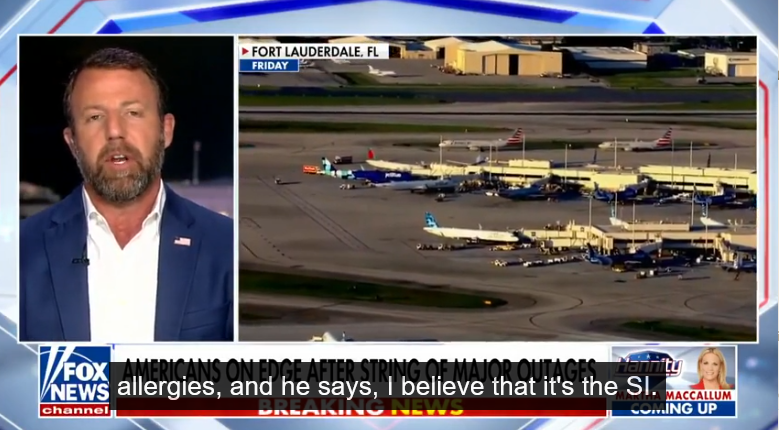
- These people will almost certainly continue to believe AI caused the ground stop for the foreseeable future, regardless of what new evidence comes out, and regardless of what Sean Duffy or other Trump administration spokespeople have to say about it. (One person who still believes the cause was AI, per his Tuesday statements on Fox News, is DHS Secretary Markwayne Mullin).
Yes, it is suboptimal that many people now are primed to instantly blame AI for anything bad that happens with technology, even if there is no evidence that that's actually what happened. Yes, people should at least attempt to remain conversant with new technologies, considering that predatory companies rely upon public ignorance.
And also, I can't really blame normal Americans for defaulting to blaming AI for debacles like the national ground stop. Nor does it surprise me in the slightest that they are doing so.
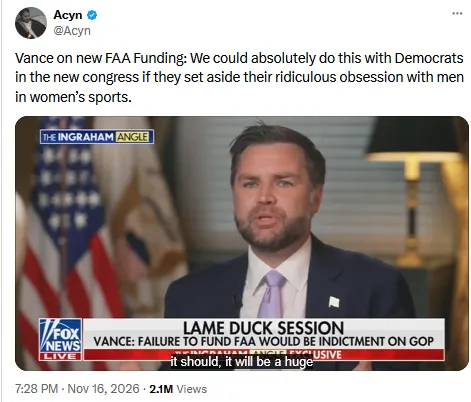
Because normal people did not create the horrifyingly degraded information environment that makes it all too easy for most people to reflexively blame AI for the Great 2026 Air Traffic Apocalypse - and that makes it all too hard for people to find good, well-validated information on how AI, and other technologies, actually work.
Big tech and MAGA did that, and they did it in the name of profit and power.
They broke our information ecosystem.
And now, just like us, big tech and MAGA are going to have to live with the consequences of almost half a decade of their own well-nigh-incomprehensibly stupid and contradictory public messaging about AI.
Because it turns out that when you spend years telling people that AI is insanely powerful and dangerous, then you shouldn't be surprised when they take that to heart. And start believing that AI is behind every single technical problem that hits the news.
I've written before (as have many, many other smart people) about the disastrous consequences of the US disaster communications environment being taken over by an unholy coalition of MAGA-backed and almost entirely unregulated social media companies. During disasters and emergencies, people seeking reliable information are all too often forced to rely upon government updates that are pushed out exclusively through Meta and X owned platforms.
On these platforms, people are not only required to make an account to view these messages - thus exposing their private data to big tech trackers - they also must wade through a festering soup of disinformation, AI bullshit, and accounts merely pretending to be government sources to actually find official information.
This dismal state of affairs is not inevitable: Meta and X could do something about it. But they don't, both because they believe a totally befouled infosphere makes them more money, and also because they're afraid Trump and his goons will yell at them over it.
This is because Trump and his goons are themselves some of the Internet's most notorious purveyors of lies, disinformation, and AI slop, which they now continuously blast out on official government social media accounts (like, say, the Department of Education posting horny Malfoid memes that are only comprehensible to a tiny contingent of sweaty fascists on X).

What's more, the current Trump administration love talking about how they're using AI to modernize the government, both because this bolsters their productive relationship with Silicon Valley's oligarchs, and also because they believe it makes them look smart and powerful.
On November 10th, the FAA's news site posted a fact sheet proudly proclaiming that its AI-powered SMART system, which is used to advise air traffic controllers, would be rolling out across the entire national airspace system, after completing a successful trial period in the DC area since September 21st.
Multiple news outlets picked up the story, which was, by the morning of November 13th, circulating on social media - along with the revelations that multiple Democratic Party lawmakers were concerned about the project, and that the National Air Traffic Controller's Union was unhappy about how the FAA had not involved them in designing, testing, or implementing the system.
In this fashion, the stage was set for the orgiastic blaming-AI ritual that took place next.
Just before 4:00 PM EST - as I was on an elliptical machine at the gym, scrolling through the latest Bluesky shitposts on Jensen Huang's extremely stupid decision to cheat on his wife with a probable Chinese spy - pilots across the nation started hearing about the National Ground Stop. And so did Flavor Flav, who was stuck at the airport himself and stood ready to serve a confused public:

While Flavor Flav was on the ball when it came to pushing out real-time updates about the unfolding national aviation crisis, the federal government was markedly less so. The FAA's notoriously crap Air Traffic Control System Command Center advisory website almost instantly became overtaxed, making it very hard to reliably load the Nationwide Ground Stop advisory that the media needed to validate Flavor Flav's on-the-ground reporting.

Nature abhors a vacuum, and so does communication. In the absence of credible spokespeople or sources, people will swiftly come up with their own theories to explain weird and unprecedented disasters, like the US air traffic control system suffering a sudden technical failure. And, go figure, they did. Social media almost immediately began to
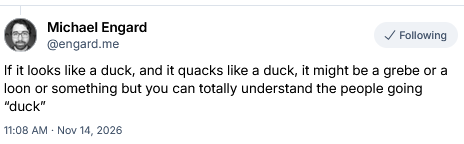
Of course people who aren't AI and technology specialists looked at the ultra-recent headlines about the SMART system being rolled out nationwide, observed the accompanying concern from both the air traffic controller union and from prominent politicians like Alexandria Ocasio-Cortez and Chis Van Hollen, and drew what at the time seemed like a pretty obvious conclusion.
To quote Michael Engard on Bluesky:
When DOT Secretary and 1997 "The Real World Boston" participant Sean Duffy finally got around to speaking to the public on Friday evening, it was almost certainly already too late to turn the public opinion ship around.
While Duffy did eventually point out that the AI-powered SMART system wasn't even connected to the overloaded routers that appeared to have caused the national aircraft communications problem, he only got there after a series of snide remarks focused on critiquing the entirely-GOP-controlled Congress for not giving him more money.
Over the weekend and into Monday, Duffy et al released more details, telling reporters that the outage was caused by a failed migration from copper wires to fiber-optic by venerable tech services company L3Harris. The administration also continues to stress, along with FAA administrator Bryan Bedford, that none of it seems to be related to AI. Trump, entirely expectedly, continues to blame the Biden administration.
Unfortunately for both the Trump administration and for big tech, it's way too late now to change the general public assumption that AI Done Did It. (And if any pollsters are reading this, I beg of you, please ask Americans this question soon).
Because:
- Many Americans will see these rather technical statements, find them confusing, consider the source, and go "I don't believe these clowns when they say it wasn't AI."
- Sean Duffy, and the rest of the Trump administration - which the American people just overwhelmingly voted against - are demonstrably clowns who tell lies.
- The Trump administration is unable to adhere even to its own dubious messaging strategy, considering that Markwayne Mullin was just on TV on the morning of November 17th - amidst yet another spate of weird online banking and United Airlines outages - speculating that perhaps the problem was AI.
- Americans have finally internalized that big tech, the makers of AI, are also clowns that tell lies - which they just overwhelmingly voted against, if you take their wholesale rejection of data centers as indicative, which I do.
Whenever something like this happens, whenever the general public rushes to a technically-suspect explanation for a major technological failure, I see a bunch of people who know a lot about the technology in question start to fume about the rank stupidity and gullibility of the masses on social media.
Look: I get it. I viscerally understand how infuriating it is when a big news story breaks and a ton of people who don't anything about the technology start confidently issuing misinformed hot takes about the stuff you work on and know backwards and forwards.
I understand it because I'm a specialist in civilian drone technology, another technology that's both very publicly visible and massively misunderstood and feared by the general public. This means that at least once a month, some big news story about drones hits, a ton of people who don't know anything about drones confidently post horrendously wrong hot takes on it, and I feel ethically obliged to spend a bunch of time trying to patiently and mostly-gently sort it out.
In that light, I have to eye roll a bit when I see some AI specialists, in the midst of yet another big dumb AI story, act like their work and their area of expertise is being particularly and unfairly misunderstood by the general public.

In my opinion, it's as pointless to complain about the average person's relative lack of technical knowledge as it is to complain about, I dunno, how the grunions flop upon the beaches to breed during the full moon in summer. It is what it is.
Either we accept it as technologists and analysts who have knowingly chosen to work on controversial tools, and make peace with the fact that we have signed up for spending the rest of our lives explaining how things work to people who are not predisposed to trust us.
Or we find something to do with our lives that people are a lot less likely to have bad takes on on the Internet about - I dunno, maybe HVAC maintenance? [[2]]
I believe that the only thing that does help dispel public distrust and fear of new technology is clearly communicating technical truths to the public in a way that isn't condescending or insulting.
Which means that if we want to see people develop more well-informed opinions about AI and other new technologies - which will, indisputably, facilitate better national-scale conversations about how we regulate and control them - then we need to get accurate information out there.
Committed as I am to doing this, I feel a little resentful when it comes to clearing up misinformation about AI.
Because AI company leaders, hand in hand with their MAGA partners, are working overtime to make good-faith efforts to dispel confusion about their own products much, much harder.
In a world in which AI company execs themselves are (mostly) metaphorically picking up a pistol and shooting themselves in their own dicks approximately every 48 hours, in the most public way possible..... well, there's really only so much a few outnumbered truth-loving posters and technically-savvy reporters can do to drown them out.
Let's consider that the US public who just blamed AI for the nationwide ground stop are the same public who spent the last two years constantly receiving messages from prominent AI and tech leaders that sound like this:
There's a 10% chance that AI could kill all humans. Or, more like a 25% chance of the future of AI going "really, really badly." Or maybe it's 70%! Many of us came to this worldview because we read a rationalist Harry Potter fanfic!
We believe that the world "should accept some bad things happening" in exchange for getting to use AI, which will also incidentally make me, Sam Altman, even more obscenely rich. But nevertheless.
Whoops, our AI agents escaped their confines (which we intentionally made easy to escape) and hacked another AI company/ChatGPT user images/an Australian government healthcare website. Silly us! I guess that proves that our AI agents are so scary and powerful that you should, for some reason, give us even more regulatory control.
We're going to use AI to look for lost dogs! And also to constantly surveil and scan your neighborhood! We're partnering with that company that makes those creepy security cameras you hate to do it! Oh shit, we're not doing that anymore because you yelled at us about it, but we're probably going to try it again when we think you've stopped paying attention!
AI will take at least half of all entry-level white collar jobs, and could spike unemployment to 10-20% in the next five years. It is especially likely to take your job if you're an uppity woman or a yucky migrant laborer. You deserve it, bitch.
Despite our stated belief that we think AI has a considerable risk of killing us all, and despite our highly suspect claims that we totally plan on slowing down the pace of development, we are still going to continue building it. Because otherwise the Chinese will.
Whoops, Jensen Huang, who seemed so relatively normal as compared to the other sweaty weirdos in charge of AI, was cheating on his wife with a probable Chinese spy, and may have been diverting chips to China. But seriously, you still need to let AI companies do whatever they want, because if you regulate us, the Perfidious Communists Win.
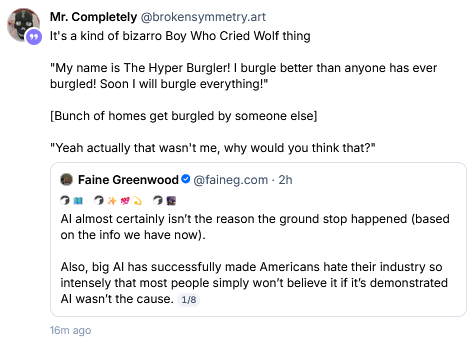
This kind of openly hostile messaging anarchy is not a recipe for getting normal people to believe you when you say that THIS particular headline-grabbing national technological failure wasn't your fault.
It just makes you sound like this:
You can also see why, given these operating conditions, I'm not feeling inclined to spend too much of my time - as some nobody poster - on providing free public education services on behalf of an AI industry that seems hellbent on ruining its own reputation at every given opportunity.
Because certain well-known OpenAI employees just can't stop themselves from posting like this:
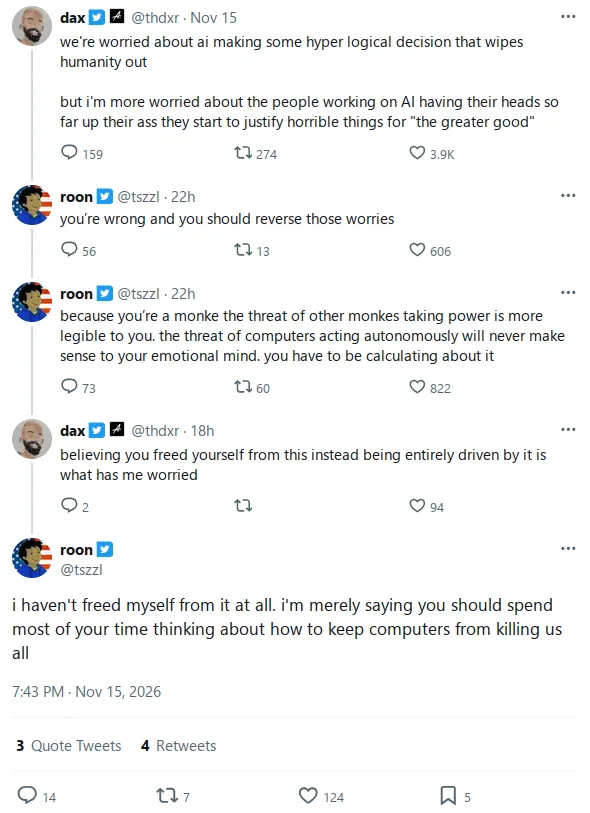
We've been living in an ever-more-broken information environment created by MAGA and big tech for years now, a sad state of affairs that is demonstrably leading to more death, sickness, and misery for the American people.
Now, in just the last two bracing weeks - between the midterm election results, the Jensen Huang Affair, and this latest aviation debacle - reality may be seeping its way back into the fart-miasma of arrogance that both MAGA and tech executives currently occupy.
Will they finally realize that destroying the systems we rely upon to make sense of the world and to tell truth from fiction hurts everyone, including them?
Will they realize that in the process of trying to cook everybody else's information environment into a mind-bending slurry of confusion, they did the same thing to themselves?
Will it occur to them that when you adhere to an ethos of moving fast and breaking things, the public will eventually run out of patience with you when you keep breaking things they actually really, really need?
I doubt it.
But the good news is that we don't have to wait around for MAGA and the dingus contingent currently running too much of big tech to figure it out.
Satisfying as it may be in the moment (and boy, is it) we can be pretty confident that yelling at people about how they're stupid and believe poorly informed things is not going to help improve. public understanding of AI and other novel technologies.
I think our time is better spent addressing the problem at the source: the ruined information environment created by big tech and the GOP. And I believe that instead of wasting our time and our emotional energy on fighting with rando posters on social media who are super-invested in believing that AI is to blame for everything everywhere, we should instead focus on breaking and regulating that unholy alliance instead.
Thanks to the Democrats success in the midterm elections, we finally have a shot at doing that. We shouldn’t waste it.
[[1]]: I do not want to argue about if AI did or didn't do it. Do not @ me, you will receive only my silence.
[[2]]: I assume a HVAC maintenance specialist will pop up in my comments or on Bluesky to tell me about all the technically poorly-informed rumors THEY have to deal with, and you know what, fair.